Sunday, 6 January 2013

FINDING A LANGUAGE


Studio Progress - Finding a Language

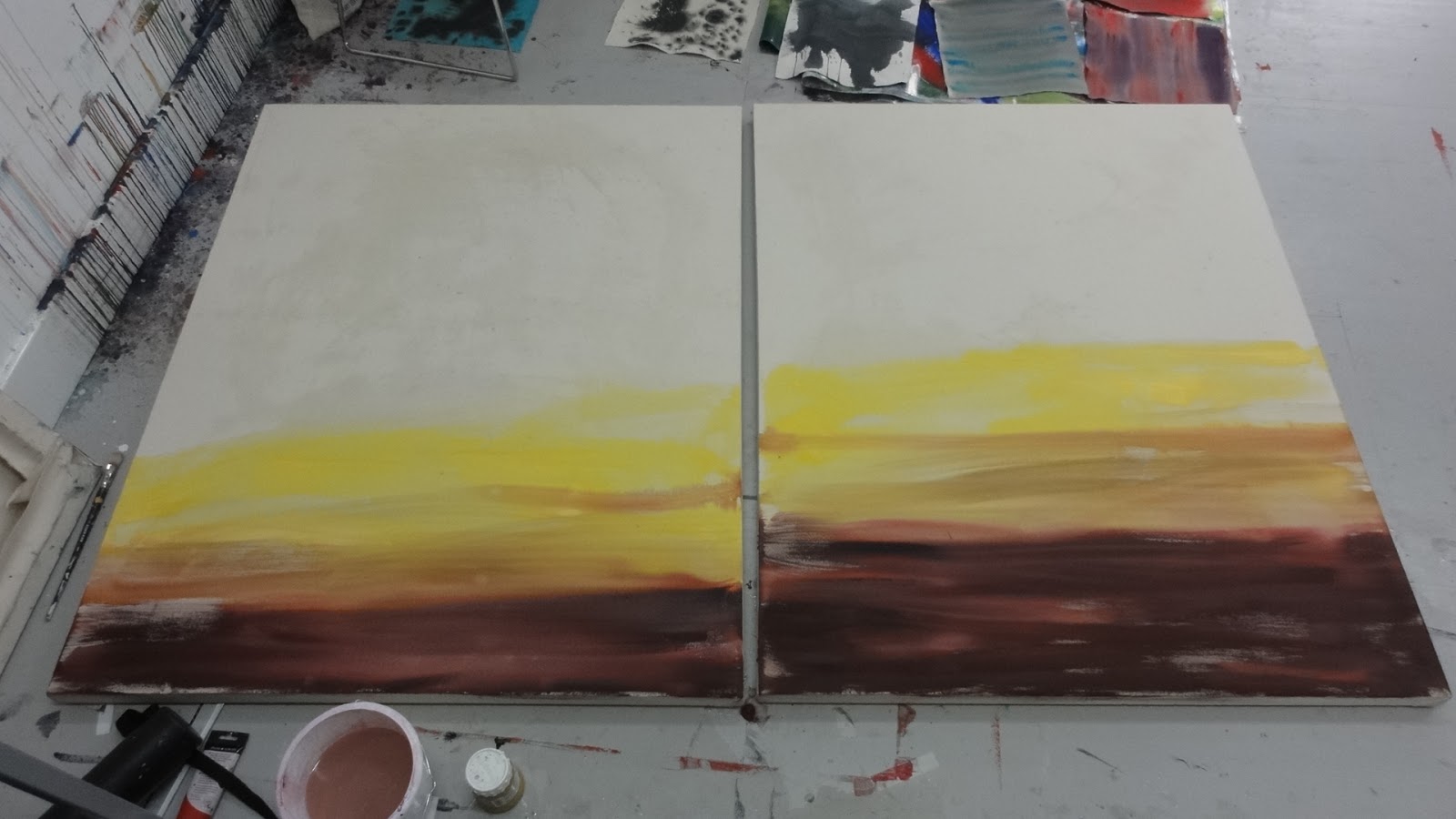
Resolve to go as large as possible within confines of the studio space  -use approx 2m square unstrecthed canvas treated with PVA diluted with one third water.

Reflection  following term end
'Traffic Lights' review and Mondrian discussion have strengthened resolve to reintroduce grids to my work. This approach seems to reflect my concerns over the 'manmade intrusions' upon a 'natural landscape' The grid reflects the inflexibility of the Cartesian view of the world and man's 'dominion over nature' The loose acrylic washes aptly reflect the natural processes - influenced by water and gravity. This provides me with,for the first time, a language with which to attempt to develop my work - no doubt this will morph into something else before too long!


Referencing Mondrian seems important - he worked so hard to remove all landscape reference (or, indeed,any other) from his work although he initailly made many studies based on landscape subjects edging towards total abstraction (e.g. his Tree Series). He sought to restrict the experience of viewing his work to the picture plane - I am trying to introduce a sense of space into the canvas without any overt landscape reference!

His grids which imply a connection beyond the confines of the picture  provide a connection which I would wish to emulate (unlike say Agnes Martin whose grids often relate to the picture itself).


Undergrid design options worked out on paper first.
Original thoughts of utilising a Mondrian painting as an underpainting are abandoned in favour of an orthoganol grid, strongly influenced by Mondrian. (This thought was triggered having seen Jim Shaw's work at the Baltic where he produced some stunning extra large works utlising old theatrical drops, most interestingly integrating the original 'theatre painting' into the finished work).
As ideas further worked up two of the strong verticals are canted slightly to the right, breaking the full strictures of the 'Mondrian grid' - this feels good and is 'my statement'.

                                                                               
Tape sizes available:  
75mm
50mm
35mm
25mm                 
                                                                                 
                                                                                                                            
Grid tape in place


First washes                                                                       
Further washes, experimenting with complementary colours - yellow / purple. Canvas lifted from top edge to allow latest wash to 'run' creating links between top and bottom of the canvas  


With tape removed
Some bleeding beneath tape 
but softening / integration of grid generally welcomed


  Observations

  •   Scale and unstretched nature of canvas quite liberating
  •   Purple /rich cadminumyellow work well against the neutral canvas -( PVA primed)
  •   Bleeding of colour into grids not intended but adds to richness of painting - would  have been major problem if the work relied on precise, Mondrian like geometry.  


Saturday, 15 December 2012

STUDIO PROGRESS


Studio Progress (11/12/12)

Further work on 'Mood' acryic wash paintings, sellectively intensifying colour..

Virginia Crit +
Discussed options for work:
  • Painted as diptych, therefore many options for relationship / orientation of the two 


  •   addition of grid / other  major intervention - there would be no turning back.   
Difficulty of introducung grids on unstretched canvas. Possibilty of weighting down but will inevitably distort canvas. 

New Work (reflecting on Traffic Lights Review)

  • Increase in scale  - possibility of using unstretched canvas straight from the roll 
Rolls come in 9ft widths. Can be mounted on 'carpet core' but not sufficient space in studio without being very antisocial!

Problem of when to introduce grid:

1) On raw canvas- likely to inhibit mark making.
    Painted on at the outset or masked out so that canvas remains. This would allow  possibilty of taking some later washes over the whole piece. 

2) After initial washes which would allow placing of grid in considered relationship with painting at this point.

Feel that appropriate grid should extend beyond the picture frame (Mondrian), rather than internalised grid (as much of Agnes Martin's work).


Consider 'homage to Mondrian',or at least covert reference!  Lift one of his grids and use as an underpainting.......

Mondrian acheived his goal of producing pictures that were pure abstraction and his journey through ever increasing levels of abstraction is well documented. Reducing everything to 'the picture plane' and a palette of primary colours' or monochrome is too controlled for my current purposes.


The challenge may,perhaps, be summarised as:
  • utilising a grid to imply activity beyond the confines of the canvas
  • using free washes with a sensation of 'space' without tipping into the representation of an overtly 'landscape space'


Thursday, 13 December 2012

THINKING ALOUD


Thinking Aloud

Traffic Lights Review

Present:
Peter Wolland (PW)
Prof Eric Bainbridge(EB) 

Gave brief resume of journey through this module


“My current work explores degrees of abstraction as a means of analysing and commenting upon landscape character.  I am interested in how natural processes and manmade interventions have determined the landscape that we see. Of particular interest is the dynamic quality of landscape appreciation, how it changes from moment to moment through changing light patterns, diurnal and seasonal rhythms. This has lead to an interest in seriality and repetition.” 


( Please view previous Blogs as record of this journey)


There followed some useful discussion points:


At what point does a work become truly abstract, without reference to its source material?
Expressed concern about total loss of link with ‘landscape’ as a source/ inspiration

EB suggested that many major artists had achieved pure abstraction but underpinned by intellectual rigour throughout their artistic journey. He instanced Mondrian’s studies of trees.


PW put down the challenge as to what might lift my work into the magic 70+ territory!

Suggested that one option would be to greatly increase scale of work and ‘see what happens’ e.g. using section of 10ft canvas on a roll that could be transported.

Developments on this will be the subject of future blogs...........


Thursday, 29 November 2012

EXPLORING ACRYLIC WASHES


Further work on acrylic washes using wet into wet.

Lining paper taped to board.
Linear mark derived from field patterns
850 x 450mm module


Further washes added to increase depth          

Introduction of charcoal 

Markmaking shows some influence from Barabara Rae

Charcoal band
Major charcoal band - marks too heavy compromising spatial recession if read as 'conventional' landscape space


Return to unprimed, stretched canvas 

Canvas   (1150x 800)well wetted but some difference in take up which makes for interesting effects which could be exploited in the futrure.

Build up of washes, treating two canvases as 'one piece'


Selective take up of red pigment due to uneven initial wetting of canvas.     

Gravity  used to take paigment down across canvas - limited control but some interesting effects


Orientation of canvas an issue                             


    Landscape format most interesting to date

Thursday, 22 November 2012

MORE WORK ON WASHES

Issues:

Developing wet into wet
paintings (acrylic on paper).

Discussion with Lothar who reckoned that vertical format single brush expressions were little more than mark making and it is difficult to imbue much content.

However, experiment with more marks so that paint rather than 'space' dominated the ground.

Composition also an issue - often more effective to co-opt an actual structure rather than invent from a 'blank canvas'.

LG suggests trialing acrylic directly onto unprimed canvas. Also discuss with Virginia and it seems there are two schools of thought as to the most effective technique:
1) directly on to unstretched canvas laid horizontally
2) using very taught stretched canvas.

Initial trial using unstretched canvas


Canvas thoroughly wetted to ensure          uniform moisture content

Acrylic also fairly diluted to help acheive a 'suffused backgrround'


Initial results indicate unstable uptake of pigment where it is very difficult to predict / control the result.

Results left show continuing bleeding and loss pigment       colour.


Lower picture taken one hour after top picture


Two trial panels


 Shows limited and unpredictabe uptake of pigment